Bridging engineering and product strategy. I code, I architect, and I take products to market. AI tools accelerate the build — the product thinking is still hands-on.

I've spent two decades in roles that don't usually overlap — someone who can follow the engineering, understand what's actually being built, and translate that into messaging and strategy that lands. At startups that meant wearing every hat. At larger companies it meant bridging the gap between teams.
I code, I architect, and I use AI tools to move faster. The product decisions, the tradeoffs, the positioning — that's still where the work is.
Currently working on AI memory elasticity at Phison. Previously at NVIDIA, Lambda Labs, Corsair, and ASUS. Hack Reactor for the engineering foundation.
Built to solve a real problem: how do you validate that AI workloads actually create memory pressure under production conditions? This isn't a mock or a simulation — it ingests real competitive data (CES 2026 corpus, 87 documents), swaps live between Llama 3.1 and LLaVA on demand, and streams telemetry as the memory pressure builds in real time. The engineering was the means, not the point. The point was proving that multi-model AI workloads genuinely stress GPU memory in ways the market hasn't fully reckoned with yet. FastAPI backend, WebSocket streaming, RAG with context pruning, crash detection tied to real swap deltas.

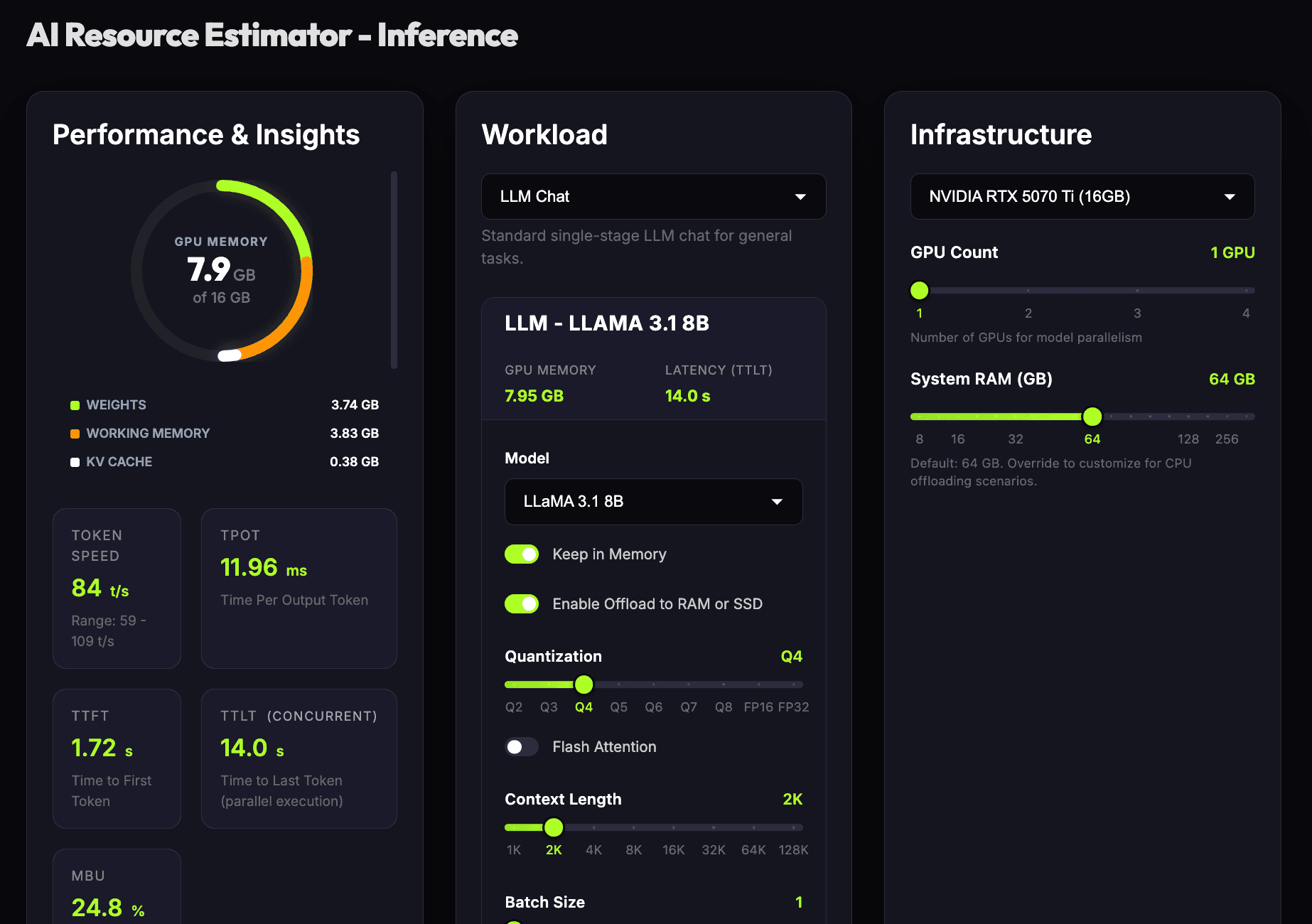
A VRAM and performance calculator for LLM inference pipelines. Not a toy — it models KV cache scaling, multi-GPU topology, CPU offload penalties, quantization tradeoffs, and multi-stage pipeline orchestration (RAG, vision, agentic workflows). Built because I needed to understand memory pressure before I could demo it. Live on Vercel, roadmap in the repo.

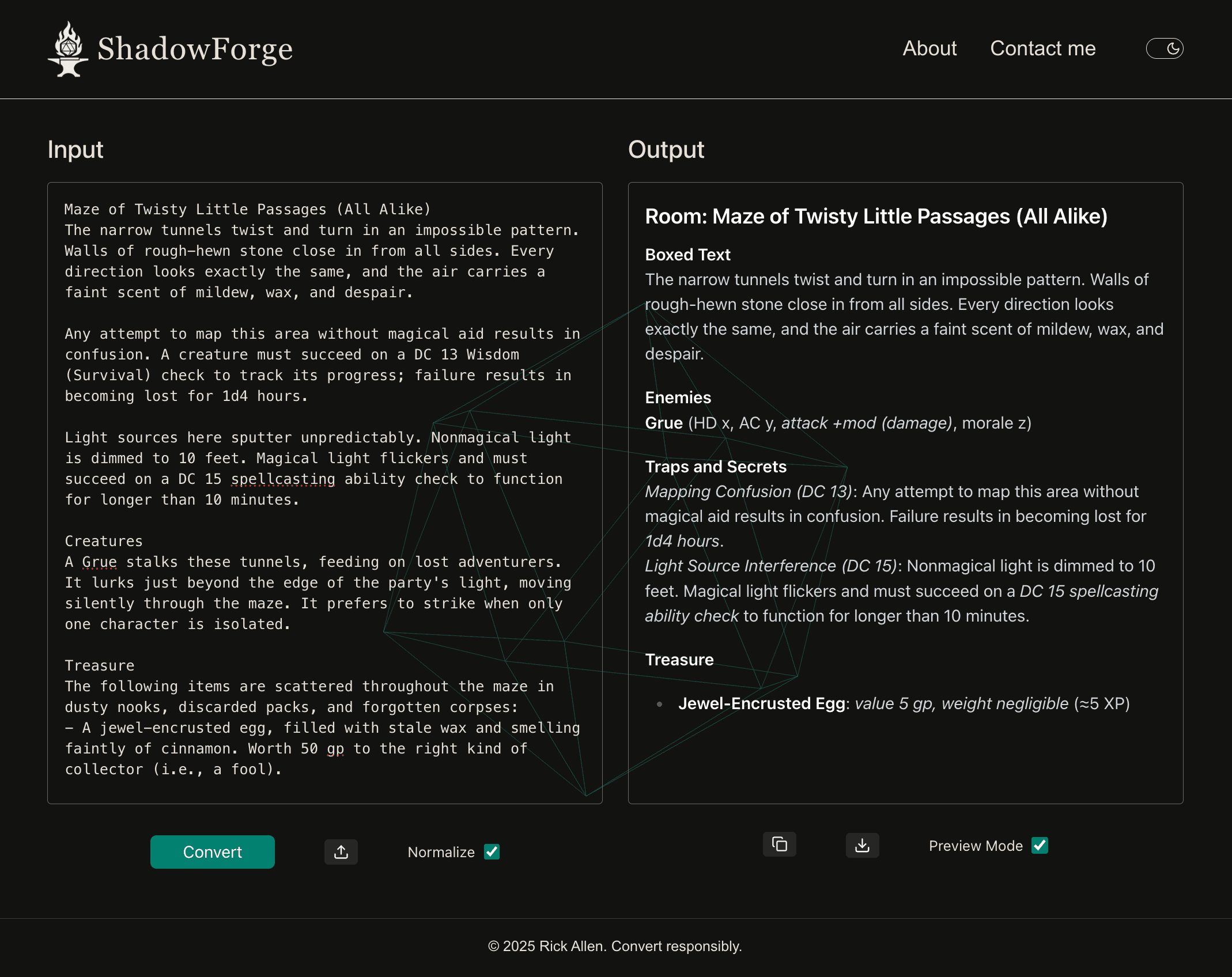
Converts D&D 5e adventures into Shadowdark RPG format using OpenAI. Real users, real use case — the tabletop RPG community needed this and nobody had built it. Token-aware chunking, markdown output, client-side token tracking. The project where I closed the full loop: identified the gap, scoped the product, built it, shipped it, people use it.
Inference runtime orchestration and RAG architectures.
Modern, component-driven interfaces alongside complex state.
High-performance API design and real-time streaming.
Containerized deployment, persistent state, and telemetry.
Leading messaging and go-to-market strategy for the aiDAPTIV AI memory elasticity platform. Working cross-functionally with technical marketing, engineering, and partner teams to improve demo narratives, benchmark interpretation, and proof-point clarity, ensuring external messaging aligns with actual product behavior and market expectations.
Advised on product definition and go-to-market strategy for an early generative AI marketing MVP. Worked with founders, ML, and engineering teams to clarify target use cases, define product requirements, and shape LLM-powered workflow concepts. Contributed messaging and positioning guidance for AI-assisted campaign planning and automation ahead of a planned launch.
Led go-to-market and demand generation for GPU cloud services and AI infrastructure, managing a $3M annual marketing budget. Mentored the PMM leading the Tensorbook laptop launch, and drove its PR and influencer programs. Established technical influencer partnerships to build awareness and credibility with developers, researchers, and AI practitioners.
Worked as a mobile software engineer on a cross-platform iOS and Android application using Flutter and Firebase. Collaborated closely with product and design in an early-stage startup environment to build and stabilize features through beta testing on TestFlight.
Led product marketing for the HALO autonomous vehicle SDK, supporting OEM pilot programs with API documentation and runtime tooling. Defined technical messaging and platform positioning for enterprise automotive customers, working closely with engineering and business development teams.
Provided product marketing and go-to-market consulting for hardware and technology companies. Developed competitive positioning frameworks, messaging architectures, and launch strategies. Generated substantial earned media coverage through PR and influencer outreach, supporting product introductions across multiple hardware categories.
Led marketing, PR, and creator programs for PC gaming hardware, with 5 direct reports and 9 regional coordinators. Moved review samples to YouTube creators such as Linus Tech Tips, growing per-video views from 50K to 600K+, and ran a review program that won 547 awards in 2013.
Product PR and partner marketing for notebook GPUs and HD video. Created a partner program adopted by Dell, HP, Toshiba, Sony, and Gateway.
Led North American marketing and channel partner programs for PC hardware, including co-funded campaigns with Intel, NVIDIA, and AMD.
Led marketing for Trident's first 3D graphics processors, and product teams delivering over $50M of products a year.
Managed the $25M ViRGE/GX2 graphics chip program through a yield crisis, and led AGP validation with Intel.
My background is diverse: product marketing, solutions marketing, PR and communications, events, BD, and software engineering, across semiconductors, PC hardware, consumer electronics, and AI infrastructure. For the full picture, see the long resume.
Long resume →Happy to talk about AI infrastructure, product marketing strategy, AI/web development, or anything at the intersection of the two. Or you want to debate whether you are likely to be eaten by a grue in dark mode. Either way, I'm in.